Calling all IELTS teachers:
IELTS Laboratory is basically the online textbook I wish existed for IELTS Academic Writing.
It solves the usual headaches:
No more patching random PDFs to teach online (works on mobile too)
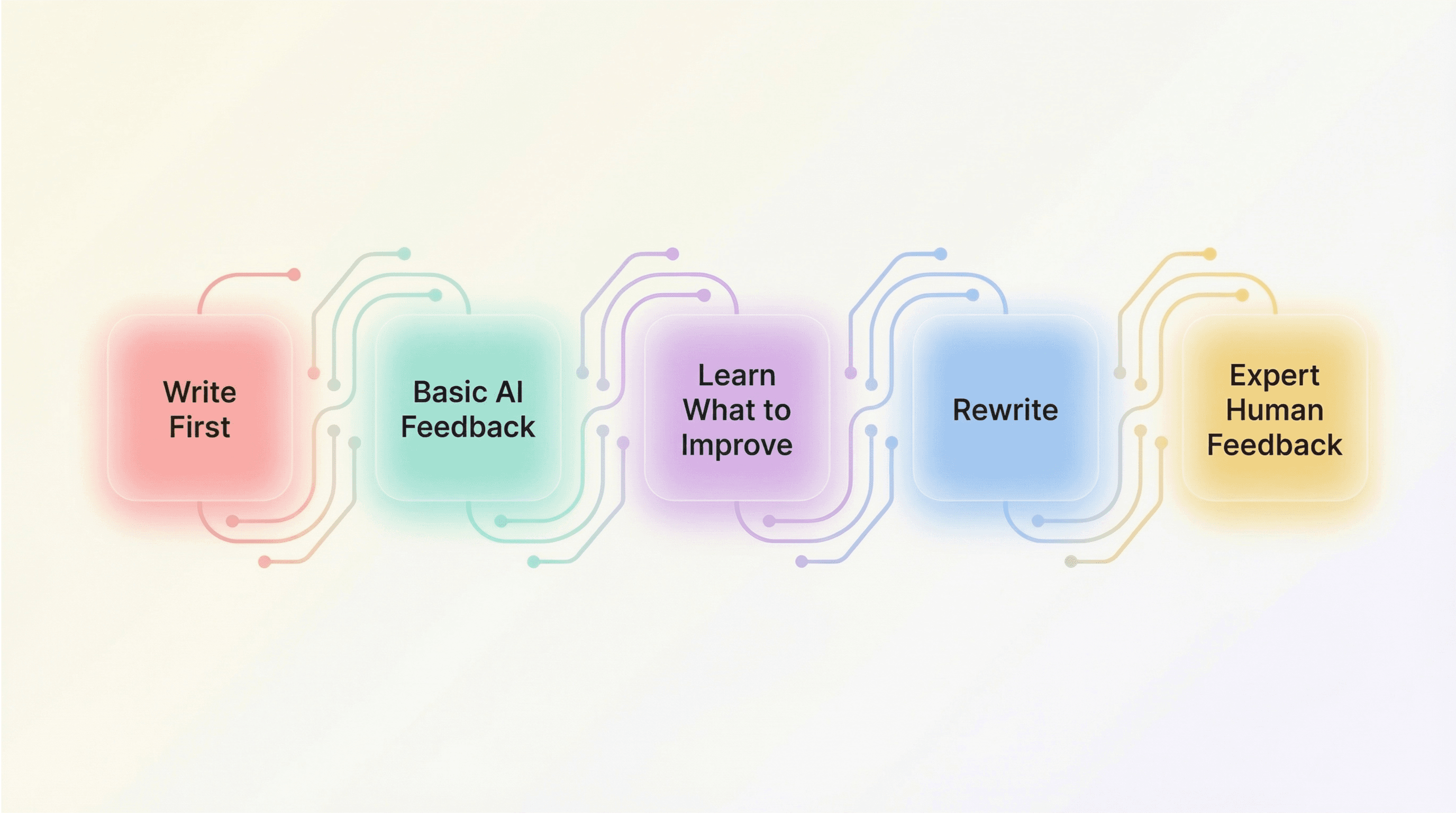
Students actually write first, then understand what needs to improve with focused feedback
Rewrite is built in, so feedback gets used
Feedback stays focused (top issues first, not massive error lists)
You can track improvement over time because progress metrics are stored in one place
Less lesson time spent re-teaching basics and less teacher talking time; you can use class time for discussion + speaking task practice
AI is used on the platform to give basic feedback on tasks, but that is optional and the teacher is always recognised as the final authority. More about that here.
Teaching problem | Typical approach (what happens) | IELTS Laboratory (what changes) |
|---|---|---|
No proper textbook for IELTS Academic Writing | Teachers patch books + websites | A single shared resource focused only on Academic Writing |
Teaching online relies on PDFs because no online textbooks | PDFs are awkward and unprofessional | Accessible on any device (including mobile) for self-study |
Hard to show improvement over time | Progress is vague (“seems better”) | Development metrics are stored in one place as evidence of learning |
Students fixate on vocab lists | Not enough time spent on improving important areas | Focus stays on completing exam tasks; performance is the evidence |
Too much class time explaining basics | Lessons become repeated lectures | Students arrive having already written + engaged with core features |
Old materials underweight TR/CC | Language-heavy teaching, weak structure | Structure, task response, and paragraph control are reinforced systematically |
Students don’t improve after feedback | No rewrite of same task type, so feedback isn’t applied | Rewrite is built in, so feedback must be acted on |
Feedback becomes an error list | Students don’t know what to fix first | Only the highest-impact issues are prioritised |
Lessons dominated by correction | Teacher edits; student passively receives | Feedback guides better choices, not “red pen” correction |
Practice in textbooks is unfocused / filler content | Huge lists and “extra” content | Practice stays exam-relevant |
Low engagement with feedback | Students skim it and move on | Self-diagnosis + reflection are required before rewrite |
Inconsistent writing across tasks | Performance depends on topic familiarity | Repeatable writing cycle stabilises performance |
“What do examiners want?” is hard to explain | Criteria feel abstract | Criteria become observable behaviours teachers can point to |
Students rely on the teacher | Progress depends on teacher time only | Learners practise independently between lessons with clear priorities |