When AI Can Actually Promote Learning - And When It Can't
Discussions about AI in education often fall into a false choice: either AI is revolutionary and should replace teachers, or it is unreliable and should be prohibited. Neither position is very useful; a better question is how we can use AI, in limited ways, to improve learning - especially the learning of performance.
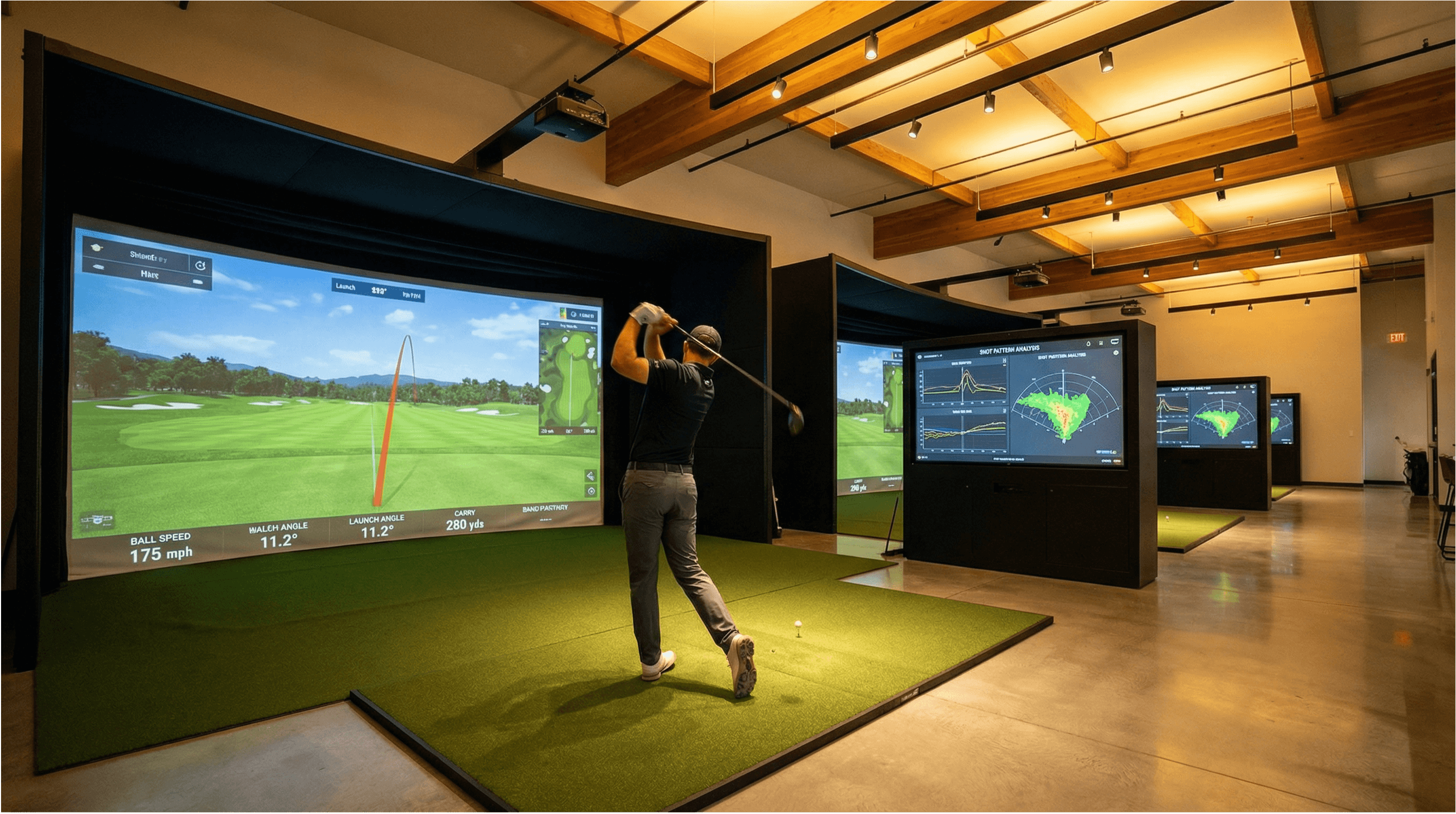
A helpful way to think about this is indoor golf practice.
Imagine a golfer practising indoors with a simulator to track the ball after being hit. The player hits shot after shot in a controlled space. The system gives instant feedback, making general errors visible quickly and showing patterns over time.
This is not the same as playing real golf. The conditions are different, the environment is simplified, and the feedback is only as good as what the system can measure. It is a training space, not the full experience of the sport.
And yet, people still do this to improve their skills, in fact the controlled conditions may even be beneficial to beginners. It allows repetition, volume, and immediate feedback. It makes it possible to practise specific aspects of performance efficiently, and it provides evidence of change over time. Crucially, it gives the player many more attempts than 'real world' practice ever could.
AI can work in education in much the same way.
Used well, AI is most valuable as a practice environment: it enables high frequency rehearsal and provides early signals about patterns in performance. It is not reliable as a final judge in high stakes contexts, because its feedback can miss nuance and misread what matters most. So teachers need to uniquely interpret what the signals mean, prioritise the next best change, and make accurate decisions in context.
AI as a Practice Environment, Not an Authority
In practice, AI can provide learners with:
instant opportunities to practise
general feedback on basic patterns and structure
rapid signals about whether something is broadly working
However, it should not be treated as a final authority.
In academic writing, for example, AI can often highlight basic recurring issues such as unclear structure/limited paragraph development, and it can do this quickly enough to support practice between contact time. However, it is less reliable for judgement on non basic tasks or providing guidance on the best next steps, etc.
That is not necessarily a problem, it's just a limitation to consider like any other. An indoor simulator can tell you that your shots are consistently going to the right, but it cannot fully recreate the conditions of a real golf course and where the ball would actually finish. Its value lies elsewhere, in training performance rather than being an absolute authority on anything. This is especially useful for IELTS academic writing because it is student performance being measured on the day of the exam.
Why Teachers Still Matter More Than Ever
Where AI offers speed and volume, teachers offer judgement.
Experienced teachers can:
interpret ambiguity
prioritise what matters most next
explain why something is limiting performance
make accurate decisions in context
These are not mechanical tasks, but interpretive ones.
In the golf analogy, the simulator provides repetitions and data, but coaches can decode what the data means, which habit is causing a pattern, and what change is most likely to fix it. Without that human layer, practice can become aimless and unproductive. Learners may improve the wrong thing, or make superficial changes instead of the real constraint.
The same is true in exam training, especially for IELTS academic writing. Learners do not just need feedback; they need interpreted feedback.
A More Honest Division of Labour
Rather than discussing whether AI will replace teachers, I think it is more productive to separate roles clearly:
AI can support practice, repetition, and general diagnostic signals to improve performance – and it is performance, not only knowledge that is needed in the writing tasks.
Teachers provide real marking, prioritisation, and guidance.
AI is not an enemy of teaching, and can actually support it.
By handling high volume practice and early stage feedback, AI can free teachers to focus on what genuinely requires human expertise: interpretation, explanation, and decision-making.
The Real Risk: Treating Training Data as Holy Judgement
Problems arise when learners are encouraged to believe that AI feedback is equivalent to expert marking, and it needs to be stressed to the student that the feedback is limited.
However, when used transparently (and in a clearly defined way), AI gives learners more chance to practise basic skills, notice patterns, and reflect. Used improperly, it can create false confidence or unnecessary confusion. The difference lies not in the technology itself, but in how clearly its role is defined.
Conclusion
AI feedback is no substitute for a real teacher feedback and guidance, just as indoor practice data is not accurate in predicting what would happen on a real golf course; however, both can play a meaningful role in developing performance when they are used for what they are good at.
The future of education is unlikely to be only AI or only teachers; I think it is more likely to involve hybrid systems that combine a) frequent practice of small basic tasks with rapid feedback to improve performance, and b) skilled professionals to do interpret errors, contextualise feedback, and guide learners.