I have been examining a small pilot set of IELTS writing submissions from learners who agreed to research disclosure for IELTS Laboratory.
The system follows a simple sequence: learners first write a draft cold, with no guidance, then receive targeted feedback, a model example, and a short lesson focused on that task type, before writing again.
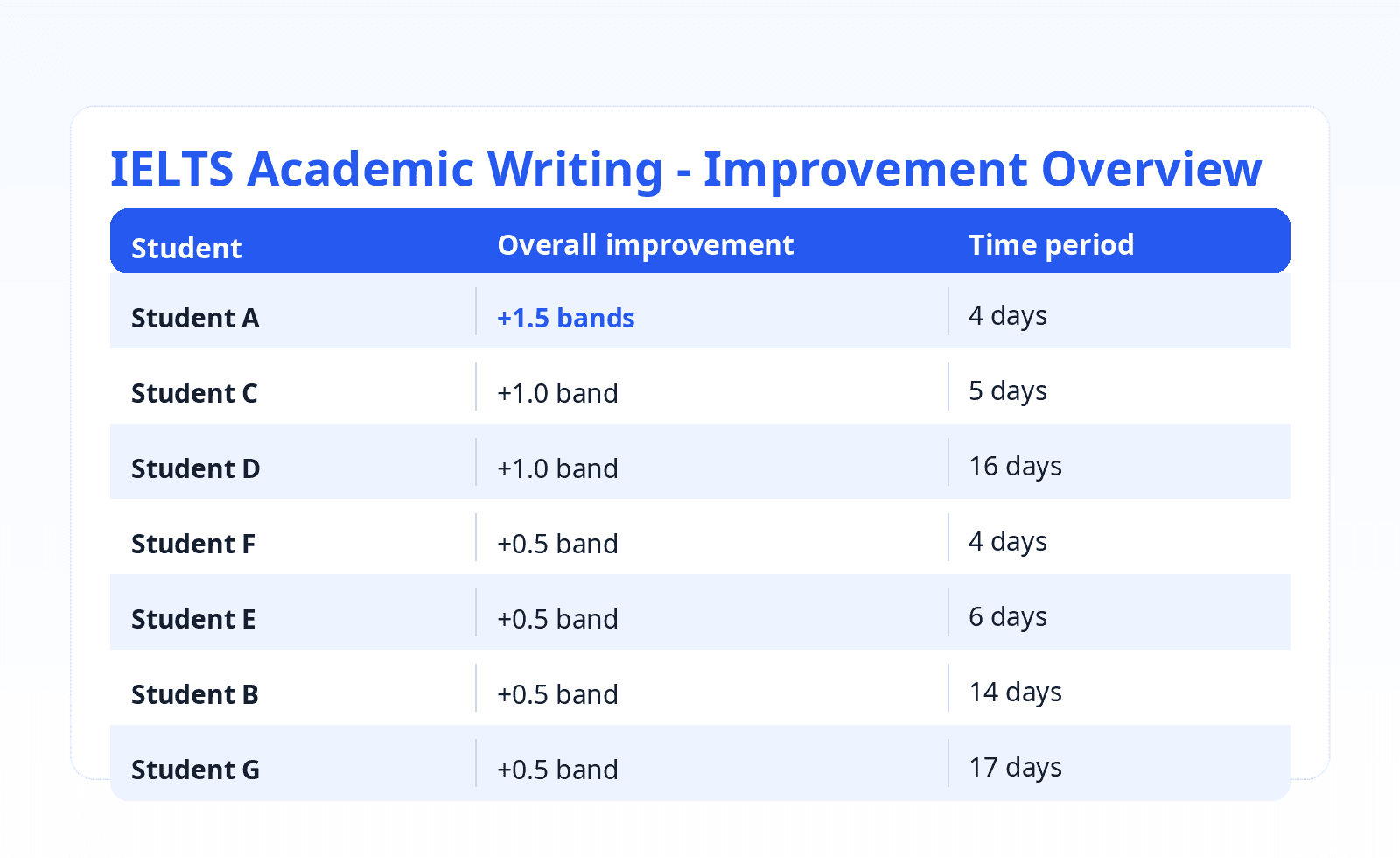
Looking across the learners in this pilot subset, all 7 showed overall improvement between their lowest and highest recorded scores: 4 by half a band, 2 by a full band, and 1 by one and a half bands.
Within draft 1 to draft 2 learning cycles, 5 of the 7 learners in this subset also showed immediate improvement in a second draft answering a different question of the same type: 4 by around half a band and 1 by around a full band.
What interests me most is not only whether the second piece is better, but what actually changes during the learning cycle.
In this sample, improvement is rarely neat or uniform. The earliest gains appear most clearly in Task Response and Coherence and Cohesion. Learners often answer the question more directly, organise paragraphs more logically, and make the progression of ideas easier to follow. In other words, the writing starts to look more like an effective IELTS response before the language inside it becomes consistently secure.
By contrast, Lexical Resource and Grammatical Range and Accuracy appear slower to stabilise. A second draft may feel clearly stronger while still containing awkward phrasing, spelling problems, agreement errors, weak collocations, or underdeveloped ideas. This suggests that the four criteria do not progress at the same pace.
There seems to be a difference between what transfers quickly and what does not. Structural learning appears more portable: once a learner develops a better sense of paragraph purpose or task coverage, that improvement often reappears in later writing. Language control is less stable, and vocabulary or grammar problems are more likely to return.
The sample is small, but the pattern is notable: in this pilot subset, all selected learners improved overall across their recorded scores, and several also improved within particular learning cycles. This suggests that the sequence may support both longer-term development and shorter-term transfer.
Questions for IELTS professionals and teachers:
Does this pattern align with what you observe in your own teaching or marking?
How do you prioritise feedback order, task response and coherence first, or language first?
Have you found effective ways to accelerate improvement in Lexical Resource and Grammatical Range and Accuracy so they catch up more quickly with structural gains?